This years end of year London exhibition, held by the current second year fine art students will be held from 23rd – 26th May 2018 at The Maverick Projects ‘Safe House 1’ 139 Copeland Rd London, SE15 3SN. This exciting contemporary show includes work from the entire year with a few site specific works being created especially for the space. Safe House 1 is a semi derelict semi-detached Victorian suburban house which has been partially gutted to reveal roof timbers, inner wall cavities and bare floor boards giving the exhibition space a unique character and feel, most definitely not a white cube environment. http://www.maverickprojects.co.uk
I have been struggling to find a piece of work which I wanted to submit for this exhibition and am at this point still a little unsure but have been working on an idea for a little while and it may possibly work. Having a long facination with history and especially medieval art and manuscripts I wanted to bring that kind of art and perspective into a modern painting. Works such as those by Giotto and Cimabue are facinating but also that of the humble but educated monk whose illuminations and marginalia in bibles and manuscripts make each and every work a masterpiece.
I recently accired some pre-owned and used canvas’s from another student with the aim of painting over the existing image and reusing the canvas. Some of the canvas’s were quite large and some were printed with the american flag, the stars and stripes. I thought about appropriating the flag with a medieval style image over the top. Due to the recent stories coming out of America about Trump and fake news I thought i would do something along the lines of Make America Great Again as per the Trump logo.
It is still a work in progress and may not be used for the London exhibition but to day i have been working on a rendition of an early medieval psalter page illumination over a thinly white washed stars and stripes. The illumination is called ‘Hell Mouth’ and is from the Winchester Palter (c1150). and depicts an angel locking the gates of hell trapping all the evil and demons within. (fig1)
fig 1. Hell Mouth, Winchester Psalter (c1150)
I did not want to copy the image exactly but very much using the initial concept I firstly drew out the image onto the flag canvas and then in oils painted my version over the top. I changed the square edges of the original into a ‘Tablet’ shape to represent a modern digital platform rather than a velum folio in a manuscript. The canvas is 70x100cm and the painted image is approximately 44x60cm making it much larger than the original. As the work is unfinished it will obviously develop a little more. One addition i am looking at is some Latin text as per the original 12th work. I have researched the Trump term ‘Make America Great Again’ and in Latin that reads as ‘Americae Facit Magna Resum’. It is to be seen if I include it yet or even include the work in the exhibition at all, Still nearly 3 weeks to go to decide.
For my second-year work experience task I was torn between approaching a practicing artist, to gain experience and knowledge in a practical hand on fashion to contribute to my own practice and a museum to gain knowledge of curating and possibly art conservation.
I initially contacted The Watts Gallery, http://www.wattsgallery.org.uk near Guildford in Surrey with a view to gain experience with curation and conservation, but unfortunately, they had already taken an intern and were unable to offer me a position. Having been unsuccessful with a museum together with already having previous gallery experience in the retail sector I pursued the artists studio approach.
On visiting The Ox Market Gallery in Chichester during a group exhibition of local artist I was very much taken with the work of One particular artist, Kate Passingham, a figurative painter who also particularly likes to work with pastels and charcoal. In a room dominated with amateur representations of Chichester Cathedral and still life paintings Kate’s image of an East African boy stood out for its technic, execution and use of material, especially Gold and Silver leaf which I have used myself in the past year. After the exhibition and on looking through her website and social media pages I thought Kate would be a good artist to contact. http://www.katepassingham.co.uk I was intrigued with Kate’s subject and use of materials and wanted to learn more, not just of the back ground but also the technics employed and how I could bring that knowledge into my own practice.
I initially contacted Kate on 10th April through her social media page and she was very receptive and was happy for me to visit her studio in West Sussex but due to work commitments and commissions was unable to do anything until the beginning of May. I arrived at Kate’s studio at 10:30 on the 5th May as arranged which was the opening day of the Chichester Artists Trail which Kate was part of and was welcomed very warmly. After introductions and pleasantries, I was left to look around the studio and at the display of completed works which were for sale. After a brief time, we were talking in detail about her background and education we there were strong similarities with myself and we seemed to get on very well. Once sitting in the studio, I was keen to learn more about the use of gold leaf as well as silver and copper leaf and her technic. We went through several types of leaf, which ones were best used for larger areas and more back ground work and then ones for finer detail, together with the different adhesives used, this was also slightly regulated by the other materials used on the work, pastel on paper, oil on canvas for example. Not having much experience of pastel and charcoal work I was keen to learn.
During this time, we were in conversation about her influences in creating a large body of work based on the people from West Africa, especially The Gambia. Kates background and origins are in West Sussex so West Africa seemed an odd direction. Kate explained that during a holiday there a few years ago they were visiting a small village and she was completely struck by a teenage girl who had piecing Blue eyes, yet very dark skin, Kate asked if she could take a photograph and sketch her. This was the start of the project. After gaining the girls acceptance Kate was allowed to photograph and sketch various members of the girl’s family and to explore other residences and other families. (fig.1.)
FIGURE 1 ‘BLUE EYES’ (2017) KATE PASSINGHAM
The whole of this series which includes large and very small works in completed with pastels and charcoal on paper or board. The ground is primarily 22ct gold leaf laid out in a visible grid design with a very accurate depiction of the individuals face and paying particular attention to the clothing and hair. One of the fascinations for both Kate and myself was the juxtaposition of ethnic traditionalism and modernity. In the large work entitled ‘Welcome to Africell’ (2017) (fig 2) there is a depiction of a Gambian women in traditional dress with a blue water bucket resting on top of her head and yet she is walking past a modern yellow Africell logo which is the main telecommunication company in The Gambia and printed on her traditional looking dress are images of mobile phones.
FIGURE 2 ‘WELCOME TO AFRICELL’ (2017) KATE PASSINGHAM
After moving on from the Gambian series we were looking at her commissioned portraits which are usually completed in a traditional romanticised palette of soft colours and tones or slightly staged with an ethereal pre-Raphaelite feel to them. Kate was explaining about ‘paying the mortgage’ and sometimes having to accept commissions in order to survive as a practicing artist. These portraits although very accomplished did not hold the same quality as the aforementioned works.
Kate went on to show me about her framing techniques and choice of materials and mounts, which generally, remains the same for economic reasons and ease of use. She was very comfortable with the materials she knows and works very fluidly with them due to knowing exactly what will happen and what the end results will be.
By the end of my time with Kate she had made a couple of sales due to the studio being open to the public, a couple of small prints and the collection of a commissioned work. I had been very impressed not with just how she went about the actual process and production of her work but by what influenced her and where the inspiration came from. Although Kate enjoys the commission work it is a means to an end, her passion for the materials, tone and colour are very evident.
A body of successful work came from what was essentially a series of holiday snap shots but turned into something much more important and meaningful. The context of the work I found exciting and how a body of work can be represented in either a series or just as a collection inspired from a singular moment. They don’t all have to be of a uniform size or scale, that I found important. On departure Kate was very respectful and wished me luck in my studies.
On returning home I felt it was a successful day and I learnt some valuable insights in to materials and their usage, how to vary one’s techniques and to sometimes go with the flow, ‘let things happen and develop naturally’.
Taking the theme from the ‘Still 4’33’ project and using the images recorded during the event I want to explore the images further through paint. I want to try an capture the greyness of the environment highlighted with bright colour of the buses and clothing. I would like to try and achieve this in a very ‘painterly’ fashion with loose brush work and non descript figurative detail whilst moving away from my previous fixation of 20x20cm square canvas’.
One of the influences behind this is the work of the French photographer and pioneer of street photography Henri Cartier-Bresson (1908-2004). Cartier-Bresson was a pioneer of the genre of street photography and viewed photography as capturing a Decisive Moment.
and also by work by polish painter Wilhelm Sasnal (b.1972) who paints in a simplistic block style from historical photographs and images taken by himself.
‘…it’s not to everyone’s taste’, he says, ‘like stilton cheese or ripe camembert’ (Sooke, 2018). Appropriation artist Glenn Brown self-disparaging comments regarding his work litter his interviews throughout his 30-year career. This essay will examine Brown’s Gothic tendencies and preoccupation with death and decay, the controversy concerning his Turner Prize nomination and the copyright lawsuit that followed, and finally his most recent work. Although Brown is also a sculptor, only his painting will be considered thereby concentrating upon one media to deliver a thorough study of the subject. In conclusion this essay will find that Brown appropriates because he is an active art historian with a passion for method and continues to do so despite acerbic criticism and copyright infringement claims.
He was displaced. Hexham-born (1966), a North-East boy transplanted to the rural, ‘isolated flatlands’ of Norfolk where he grew up (Brown, 2014). Amid the shortages wrought by the Three-Day Week, the rise of Thatcherism and the launch of Pot Noodle, Glenn Brown wrestled with his religious scepticism and homosexuality, an adolescent imagination which created multiple alternative worlds, and a liking for Gothic horror (Steiner, 2009:p. 12. Brown, 2014). Isolated and culturally divergent, he found solace in the Art History section of his local library and museums (Steiner, 2004: p.96). The macabre became his fascination (Jeffries, 2018) and he found his identity aligned with a Gothic lifestyle which allowed him to be outrageous (MacRitchie, 2009:p.97) and to irritate ‘because it was fun’ (Sooke, 2018). In an art education which culminated in an MA at Goldsmiths, Brown learned from Michael Craig-Martin the complex philosophy of inspiration: of the impossibility of achieving originality because any work truly original would be incomprehensible (Jeffries, 2018). Brown admired the vulgarity displayed in the works of David Salle, Julian Schnabel and Sigmar Polke as well as the clever use of colour and perception by Pablo Picasso and Henri Matisse (Steiner, 2004: p.95). In addition, post-graduate Brown was ‘burdened’ by Gerhard Richter’s theory that true originality does not exist but is instead a by-product of an artist’s life experiences and exposure to the work of others (ibid). Upon graduation Brown’s work found its place alongside Young British Artists at Charles Saatchi’s Boundary Road Gallery and in 1997 was included in Sensation, an exhibition at the Royal Academy. However, Brown dissociates with the Young British Artists stating that he was never a member of the group, that it was their differences which defined the YBA (Brown, 2009) and he insists he is ‘…not a good modernist’ (Gingeras, 2004). However, Brown had been identified as a relevant and contemporary British talent, his nomination to the Turner Prize in 2000 a seminal moment. Among Brown’s works, The Loves of Shepherds (fig.1.) is curated into the Turner Prize exhibition.
fig.1. The Loves of Shepherds (after Double Star by Tony Roberts ( 2000)
The inspiration for The Loves of Shepherds was taken from an illustration on the wraparound cover of Double Star (fig.2.), a 1974 science fiction novel by Robert A. Heinlein. The illustrator was Tony Roberts, Roberts had received £180 for his work (Daily Telegraph, 2000).
fig.2. Double Star by Tony Roberts (1974)
It was reported that shortly after the exhibition opened visitors recognised Brown’s work as being a copy of a relatively obscure 26 year-old novel’s cover illustration (Telegraph, 2000. BBC 2000). A sceptic might suggest that controversy is excellent publicity for the Turner Prize. However the story reached the press, in November 2000 Glenn Brown found his work subjected to media scrutiny and scathing criticism in a very public forum. Originality and copyright in art became a hot topic, and a debate began which still smoulders eighteen years later. The artist of the book cover, Tony Roberts, was alerted to The Loves of Shepherds and initially responded positively. He was ‘amazed and flattered’ by Brown’s work and its place in the Turner Prize exhibition (Daily Telegraph, 2000). However, upon being enlightened that a painting inspired by Sci-Fi illustrator Chris Foss by Brown had sold on the secondary market for £3.5m his tone changed:
‘On a personal level this shows a complete lack of courtesy. Glenn Brown has obviously made a lot of money out of this. He has sold the painting. He has been shortlisted for a prize. None of this would be possible without my painting. There is a certain amount of resentment, and I do feel indignant that this guy is making money and getting credit and not giving me any’ – Tony Roberts
(Daily Telegraph, 2000).
Roberts felt he should receive money and acknowledgement, in that order of priority the evidence suggests. On the evening that the Turner Prize winner was announced, Roberts approached Brown hoping to sort the matter out between the two of them when that was not possible legal action was taken for copyright infringement (Roberts, n.d.). Despite a two-year legal battle which cost Brown £140,000 in legal fees, all the money he had earned from his paintings at that time (Lillington, 2014). And yet, this could have been avoided had the painting been labelled correctly as The Loves of Shepherds (After Double Star by Tony Roberts) thus crediting Roberts fulfilling his wish for acknowledgement. Brown’s work had been labelled correctly attributing his sources before 2000. His science fiction paintings inspired by Chris Foss and John Martin had always been labelled with their title followed by the bracketed acknowledgment before the Turner Prize (Higgie, 1999). However, in the catalogue for the Turner Prize exhibition there was no reference to either Heinlein’s novel or Roberts’ illustration, it stated only that Brown’s work is inspired by other artworks or from films (BBC, 2000). This gives weight to the theory that the Turner Prize invited controversy for publicity. The chairman of the Turner Prize jury in 2000, Nicholas Serota, appeared on BBC Radio 4’s Today current affairs programme stating that the painting did not plagiarise Roberts and correctly observed that Picasso had taken inspiration from Rembrandt going as far as to use the term ‘borrowed’ from Rembrandt (ibid). Equally, Dali and Halsman had created a photomontage of Dali as the Mona Lisa in 1953. In fact, reworking dates back throughout art history particularly during the Renaissance (Latin: rebirth) when Roman art was copied, embellished, used as inspiration, and thus was reborn by artists such as Francisco de Holanda (1517-1585) who made celebrated replicas of liturgical art for the Portuguese court (Calvillo: p.501). The Loves of Shepherds became controversial in 2000 because its source was not acknowledged directly, and unlike Di Vinci and the artists of Classical Roma, Roberts was still living and had not been approached to give his permission for Brown to use his work. Chris Foss and John Martin had given permission to Brown to use their work, although Foss admitted that he did not fully understand Brown’s work when granting permission and regretted this after Brown’s Turner Prize nomination (Anders, 2014). The Turner Prize received a lot of publicity from the Brown/Roberts controversy. Originally the story broke in The Times and was then picked up by the BBC and spread to other news networks. The Turner Prize went from the arts supplement to the news pages with a well-timed controversy. Brown recalls the misery this caused him. Two years of expensive legal argument resulted in him almost losing his house and giving the lawyers what he calls ‘a fun time’ (Brown, 2009).
Legally, Roberts could argue breach of his copyright under UK law. While Brown’s paintings approximate and elaborate by stretching and changing colours and textures, whether this is too close to the source material to breach copyright became public and legal debate. Roberts v Brown, as stated above, settled out of court two years later and remained legally undetermined. In order to establish whether a work breaches copyright a visual connection must be made between the original work and the secondary. A copyright breach is considered if the secondary is considered to have been substantially derived from the original – a quantitative value, not qualitative. Should art critics or art professionals be asked to judge whether a work has breached copyright their trained opinion would judge the works qualitatively, and therefore non-art professionals are used as ‘impartial’ judges. These are referred to as ‘non-visual experts’ (Artlaw, 2014). The two images are placed side by side and the non-visual expert is asked to observe configuration and perspective as well as shape and composition to establish a visual connection. While non-visual experts found this link between Roberts and Brown’s works, art professionals agreed that Brown’s work was qualitatively, aesthetically, different from the original (ibid). Art was on trial, and art and law do not make good bedfellows. Tate and the Turner Prize insisted Brown’s work was far departed from the original while non-visual experts termed it a ‘rip off’ and was ‘just like’ Roberts’ illustration (ibid). Even eighteen years later, Endleman calls The Loves of Shepherds a ransacking of another’s imagination for profit (Endleman, 2018). However, when two photocopied photographs of the works in question are placed side by side context is completely removed. While Roberts painted an illustration for a small book cover, Brown’s work exceeds two metres by three metres in size and took over a thousand hours to complete. Brown has altered the size, dimensions, colours, and most certainly the mood, The Loves of Shepherds contains the Gothic drama, a sense of loneliness and loss of gravity that belongs completely to the unique Glenn Brown, as the first part of this essay examined. It is the position of the author that Brown’s work is significantly different from the original work as there has occurred a material transformation and thereby complies with the legal precedent of Interlego AG vs Tyco Industries Inc (1989) which established that to be considered ‘original’ the secondary art work must be altered ‘materially or by embellishment’ under UK law (Lydiate, 2001). As Le Corbusier inferred, all artists steal; but the truly original artist repays a thousand fold (ibid). Brown considers his work repays his sources while acknowledging that copyright constraints are always a consideration in his work now, he insists that his paintings are a critique or a comment on existing work that surrounds him and that his extensive study of art history has shown him that Chris Foss and even van Gogh took from existing art (Steiner, 2004:p.97).
Brown could avoid controversy by painting from his own imagination and not borrow from existing works. This, however, will never happen. Still burdened by Richter and his relationship with art history, Brown remains an appropriation stalwart. Joanna Pitman believes that Brown has a virtuous technical skill and his choice to borrow or appropriate his subjects demonstrates his will to ‘choose the path of most resistance and stick to it bloody-mindedly’ (Lillington, 2014). Perhaps referring to his time as a Young British Artist, a group he distances himself with, Brown remembers he was often criticised by his fellow artists for appropriation, that he would ‘grow up’ one day and paint his own pictures (Bracewell, 2007; p.60). He does not desire to start with a blank canvas, to own his paintings entirely, to be freed from art history. He says ‘If I was in a field painting flowers Monet, Renoir or Latour would be influencing me’ (Jeffries, 2018) and even if he did paint something manmade such as a vase or a table he would still be copying someone else’s design, it would be appropriation (Sooke, 2018). Ever self-effacing, Brown says that any ‘original’ work he created would be dull, meaningless, asking ‘what am I supposed to paint that is absolutely me? I’ve no idea’ (Lillington, 2014). The evidence firmly shows that Brown was, is and will be an appropriation artist for his career, something he states is more accepted in the USA than in the UK due to the popularity of Pop Art across The Atlantic (Bracewell, 2007). His art is Pop, he declares it so, but his trompe l’oeil impasto method challenges traditional Pop media – it resembles print, for example, while painstakingly mimicking the brushstrokes of impasto. ‘My work’ he says ‘is always going to be based on something and I wanted to make the relationship with art history as obvious as possible’ (MacRitchie, 2009: p. 96).
Following the controversy, Brown left science fiction art behind him. Rembrandt became his new muse and he developed his method choosing a small section of an artwork from art history, distorting it in Photoshop and finishing his transformation by using a colour palette from another artwork, such as Degas’ ballerinas, which is a recurring colour choice for his works. He likens this transformative process to Mary Shelley’s character, referring to himself as the Dr Frankenstein of art making art from the ‘dead parts of other works’ (Jeffries, 2018). He recounts that after a show in 2000 he was critiqued by Johnathan Jones in The Guardian that he needed to stop holding back, Jones wanted a ‘larger Glenn’ and suggested he should take the path of the carnivalesque (Jeffries, 2018). His 2004 exhibition at The Serpentine Gallery was exactly that: bold, bright and definitely carnival. Post-2000 Brown’s work complies much more to the legal precedent of work having to be transformatively different to the original to be considered such by non-visual experts. ‘It’s often difficult to recognise what [the work] is based on’ Brown says, ‘because so much of the original has been changed’ (MacRitchie, 2009: p.96). The misery of legal proceedings changed Brown’s work, but he developed in ways he would not have the controversy not arisen. Brown pushes himself and his work to be more obscure, employs visual puzzles for art historians and has become a greater success for his efforts. The ‘original’ Glenn, despite his denial, has surfaced with his Gothic disposition for death and darkness dominating his work post 2004.
He explored vulgarity, rot and decay provoking reaction. ‘Art left to decay’ (Fox, 2014), ‘…obsession with the grotesque and its possibilities…hopelessly schizophrenic’ (Lillington, 2014) the critics said. Brown approves. His work is in a place between life and death, with his subjects in various states of trauma (Sooke, 2018) and to Brown this is reality whether his audience likes it or not. Additionally, his Christian upbringing and de-conversion to atheism is prevalent in his later works. The institutional Church became part of Brown’s art history narrative as he regressed back toward the works of Early Modern Europe which the Church controlled through patronage and indoctrination. Brown resents the Church’s manipulation of art for its own purpose, its use as a didactic tool (Gingeras, 2004; p.18). His appropriation of Mancini’s Fillipo Niri in Glory before the Virgin (c 1738) (fig.3.)
fig.3. Filipo Neri in Glory Before The Virgin (c.1738)
he transformed into This Island Earth (fig.4.) St Phillip de Niri is an obscure Early Modern saint, and his depiction with the Virgin holding Christ as a baby as she does again after the Passion fills Mancini’s work with a cacophony of confused visual contradictions that illustrate Brown’s dislike of Church idolatry that coerces its followers. It is fake news.
fig.4. This Island Earth (2017)
Brown admires the brush work of the original and recreates each sweep of impasto with minute brush strokes in greyscale. Layers upon layers of delicate brushwork capture each fold of material, each sinew where flesh should be found. The composition is transformed into ethereal, ghosts replace saints and immortals. It resides in a place between this world and the next, exactly where Brown’s work belongs – neither one thing nor the other, and despite his protestations: original.
This essay has shown that Glenn Brown’s work is a product of his time and the influences of his displaced youth. He did not win the Turner Prize, but the controversy that arose served as the catalyst to move his work from early to middle career in dramatic fashion. Brown’s work matured and became sharper in its wit, intellectual reasoning and fastidious execution. Roberts, who gained no money from the controversy, had nothing to show for two years of legal arguing. Selling his original illustration art from the seventies and eighties online, Roberts found a market for limited edition prints of Double Star after selling the original to an American; Roberts did not find fame but instead found notoriety because he was appropriated by Glenn Brown, it is what he is known for. However, publication houses shied away from Roberts after the law suit, and it is the suing of Glenn Brown that will be his legacy. Despite almost losing his home and being financially stripped bare, Brown did not give up. Instead he gathered himself and matured artistically. He also got married in 2004 to his studio manager, Edgar. Brown ‘grew up’ and developed his own artistic voice because of the controversy, not in spite of it. In 2018 he has had a solo exhibition in London, and has two upcoming solo exhibitions in the USA. This Island Earth features in each of these exhibitions. The Loves of Shepherds resides at the Tate, currently in room 1, a prime position. The work now appears in the catalogue as The Loves of Shepherds (after Double Star by Tony Roberts).
The Turner Prize is yet to announce its nominees for 2018.
Still 4’33” – A Social Practice Event by Michael Palmer
“Social Practice is art that is socially engaged, where the social interaction is at some point the art”: the view of American art promoter and former museum director Tom Finkelpearl from his book What We Made (2013:44). Finkelpearl moved the conversation forward from Nicolas Bourriaud’s themes of Relational Aesthetics (1998) more in line with Claire Bishop’s article “The Social Turn: Collaboration and Its Discontents” published in Art Forum in 2006. Bishop notes “…that there is a range of names for the activist wing of the less-authored practice, including socially engaged art” (Bishop, 2006). Bishop’s primary focus was on the term ‘social’, as in ‘social encounter’ across classes where the activity was centred less on specific culturally-biased sites and more on an ‘urban’ street level: real people in real places. These urban street-based events are nothing new, works such as Gillian Wearing’s London Life series of the 1990s or works by Santiago Sierra and Roman Ondak in the early years of the 21st century have all taken the idea of social interaction somewhere new and exciting. It is no longer just a ‘happening’ but an event.
Philosopher Slavjo Zizek in his book Philosophy in Transit questions the composition of an event: “At first approach, an event is thus the effect that seems to exceed its causes – and the space of an event is that which opens up by the gap that separates an effect from its causes” (Zizek, 2014:3). An event is not graded by any scientific formula or its historical significance but is a matter of perspective as perceived by its individual audience. “A tsunami killed 200,000 people in Indonesia! A paparazzo snapped Britney Spears’ vagina!” (Zizek, 2014:1) these two sensational headlines were beamed around the world and seen by hundreds of millions of people, but the majority of those outside of Indonesia remember the split-second snap shot of Spears’ lack of modesty. An event therefore could be described as something shocking, something that disrupts the motion of normal events, is unexpected, instant or fleeting.
The curatorial group for the live projects working title, ‘Interactive Spatial Arrangement’ consisted of Sonja Purwal, Jennifer Murphy, Jennie Murton, Leonardo Pitanga, Alison Alexander, Oscar Bray and myself. During the initial meeting it was decided we did not want to do an overtly political protest or agitate on a large scale but to concentrate on subtler forms of disruption. After a period of inactivity, the group were finding it difficult locating an artist to collaborate with or to agree to what guise the performance should take. Fortunately I discovered through my own research that Middlesex University runs an Art and Social Practice Master’s Degree at their Hendon campus, course leader Lorraine Leeson. After writing to Lorraine with a preliminary proposal to circulate to her students we were given details of Art and Social Practice MA student Wendy Charlton. The job of contacting Wendy was given to Jennie Murton whilst I continued looking for an alternative artist. During a search through Axis web I came across Ellen Bell, an extremely active and prolific artist based in Wales who had branched out into social practice as well as continuing with her word and language based practice. On initially speaking to Ellen she was excited about the challenge and keen to collaborate on our project. On receipt of our proposal Ellen and I discussed assorted options and opinions which I relayed to the curatorial group through social media and direct conversation. This resulted in an agreement to perform a silent disruption in a busy frenetic environment and to record the absence of intended sound, the inspiration and guide for this would be the work of composer and music theorist John Cage.
American composer John Cage (1912-1992), was at the forefront of Avant-garde experimental music following WWII. He broke with tradition exploring alternate uses of musical instruments, electroacoustic and unpredictable musical arrangements. In 1952 Cage composed 4’33” to be performed either by an ensemble or solo artist and was written for any instrument. The work was performed in front of a live theatre audience and recorded with full sound, not intended to record the musicians but the ambient sounds within the theatre. It is not a silent musical performance as often presumed, Cage’s written instruction to the musicians was “Tacet” (Latin: silent). For the first performance pianist David Tudor dressed in full evening attire approached the piano (fig.1.) sat and when ready made a very pronounced gesture of starting a stop watch and for exactly 4’33” sat back and remained motionless. At the end of the specified time the musician stops the clock, again in a pronounced way, stands up, takes a bow. before leaving the stage. Cage reasoned that “musicians who present the work do nothing aside from being present for the duration specified by the title” (Kostelanetz, 2003:69-70).
fig.1. John Cage 4’33” Defies Silence (1952)
Ellen Bell having thought about our project over the course of a few days indicated to us she would like the group to perform a silent event in the manner of 4’33” but with a less formal, staged approach as per the original John Cage piece. Ellen instructed the performance should be completely spontaneous, non-theatrical and site specific. The location and curation would be our decision. The new permanent title for the event suggested by Ellen was agreed, Still 4’33. This title pays direct homage to the original John Cage work and encapsulates the narrative and intention of the piece and therefore could have been entitled Still 4’33” (after John Cage). The term, ‘still’ indicates our time, separated from the original work by more than six decades but equally relevant in contemporary society. Additionally, ‘still’ describes the act of being inanimate – the motionless, unmoving stillness of the performers juxtaposed against the deafening, frantic chaos of the world – thus defining the term as the adjective, noun and adverb. Now that Ellen had agreed to collaborate, and the group were happy to proceed with her instruction, we returned to Wendy Charlton who had yet to come back to us with an acceptable proposal, to thank her and to advise her we would not need to take her participation any further as the brief requested that only one artist be permitted.
The curatorial team had various discussions and meetings regarding the location, curation and detail of the event with some disagreement, but finally decisions were made and a date for the performance was set for Wednesday 11th April 2018. The group decided that as there were seven of us and to avoid any choreography we would initially perform solo whilst another group member would take still photographs with a third making a film. The film of course would also capture the sound of the environment. The solo performer would be captured at first in motion then at a specific moment would freeze for the permitted time, upon completion of the task they would reanimate and continue on their way. In order to gain maximum exposure we decided that lunch time in Oxford Circus, London would be perfect for the performance of Still 4’33”. The primary reason for this location was that Oxford Circus not only has various tube station entrances to supply us with a constant flow of people, but it is the crossroads adjoining Oxford Street and Regent Street, possibly two of the most congested yet celebrated roads in the capital. The idea of performing a silent motionless activity in such a thriving commercialised area we found very engaging. On arrival and after a brief discussion the performance started with me walking up to the railings surrounding one of the tube station entrances on Oxford Street and whilst holding onto the top railing with my hands bowing my head and stretching my left leg towards the railings taking up quite a considerable section of the path. This was filmed by Leo with stills taken by Sonja. During the performance various people were forced to step sideways to avoid me with a few looking back to see what was happening. After four minutes and thirty-three seconds I carried on walking ending my solo act. Whilst this was going on Jennifer, Oscar and Alison were standing a few metres away standing in a triangle staring down at the floor as if looking closely at an object, although not choreographed they were working together. This was filmed by Jennie and Sonja. (fig.2.)
fig.2. Still 4’33” (2018)
Leo decided he would block the footpath on Regent Street by kneeling in the middle of the path to tie his shoe lace, this was probably the most successful performance due to the location by the tube exit and it was a particularly busy few minutes. Several people had to stop and wait before they could pass including a lady with a push chair. This performance was filmed by myself. (fig.3). Alison performed posting a letter for four minutes and thirty-three seconds next to a bus stop which again involved various people having to step around her diverting their travel, this was filmed by Oscar and Jennie. Jennifer subverted the flow
fig.3. Still 4’33” (2018)
of pedestrians by walking up to a pedestrian crossing and instantly stood still after she pressed the walk button. After her 4’33” she turned and walked back the way she came, therefore not crossing the road as most of the onlookers expected. This act was filmed by myself and Jennie. Finally, Sonja performed her piece at a bus stop filmed by Jennie, unfortunately within her allotted time the bus stop was not particularly busy and possibly did not have her intended effect.
On reflection, I feel the overall project was a remarkable success with the group working together and with the guidance of our artist we produced some fantastic material which I hope will influence future work. The entire group participated, and every person was successful in remaining motionless and silent for the specified time. Once all the performances were completed it was agreed we would all upload our films and images to one social media site from where we could compile and organise the footage for the public presentation and to forward to our artist. Ellen has expressed interest in using the footage or its contents on her social media pages and web site, of course sharing credit with the curatorial group.
One of the most interesting and notable facts observed from all the performances was that the public in general did not notice anything specifically strange or odd about any of the actual activities employed by the group. Stretching, tying shoe laces, looking at the floor, pressing the walk button or posting a letter, these are every day activities and would not normally be noticed at all. The defining factor and what caused the performances to become an event was the motionless state amalgamated with the length of time. The time span generated an air of confusion amongst the onlookers, they did not understand the concept of being still in that environment or space, the universal, why? Bringing us back full circle to Zizek, “…At first approach an event is thus the effect that seems to exceed its causes – and the space of an event is that which opens up by the gap that separates an effect from its causes” (Zizek, 2014:3). In this context as with John Cage’s original orchestral piece the defining factor again was time. There is a perceived acceptability of time allowed for a musician to be silent before they start to play, waiting for the conductor to ready the rest of the assembled musicians, to wait for the audience to settle. In Still 4’33” what is the acceptable length of time for tying one’s shoe lace or posting a letter? When this is observed by an onlooker their own expectations are transferred to us, projected externally so when this accepted time has elapsed they become suspicious and even agitated. As Zizek put it “Is an event a change in the way reality appears to us or a shattering transformation of reality itself?” (Zizek, 2014:5).
For the forthcoming UCA exhibition entitled ‘When Our Lips Speak Together’ to be held in the James Hockey gallery in Farnham from April – May 2018 I have submitted a proposal to be exhibit.
The exhibition explores the field of identity and media of the modern digital age. My proposal explores the issue of identity photographs used for passports, identity cards and as a politically accepted image of the individual.
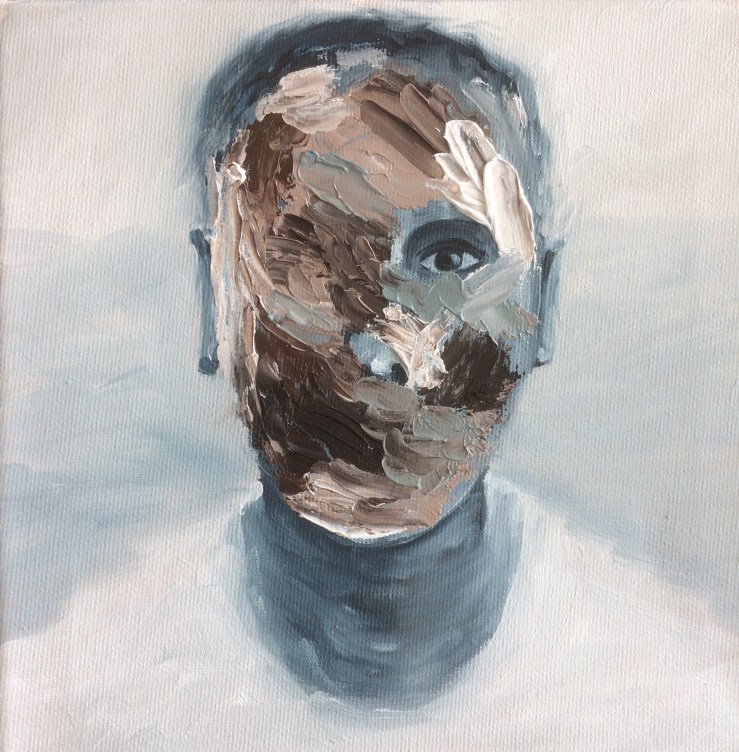
I propose to submit 4 20x20cm oil on canvas paintings of my own passport photograph. The original image is ‘Acceptable’ and is a ‘true and honest representation of me Michael Palmer. The for proposed paintings will also be me but with various areas disguised or blurred rendering the image ‘Unacceptable’ and therefore flawed and useless. To date I have completed the first painting and currently working on the second.
Following on from my previous blog I have completed the first 8 paintings in the new series. Each painting is 20x20cm using oil and canvas.
The initial idea was to follow a photographic principle and produce paintings similar to the original photograph but not trying to replicate it completely, colour photos were painted either black and white or in a very muted tonal palette. The series could reflect different pages in a photo album, each one having a narrative but without knowing the individuals identity. The narrative may be historical or contemporary that is up to the viewer to decide.
After the last few projects I feel the need to move on from what I was doing, I felt I was just upcycling stuff found and discarded. I am drawn back to figurative painting. I have a number of small 8×8 canvas’s some of which are left over from the Iconography project and indeed some are covered in gold leaf and ground.
I am also drawn to the idea of creating a series of identical sized paintings to be displayed as one resolved work similar to works by Ellen Gallagher. I have enough canvas’s currently to make a series of 12. One theme could be figurative scenes of people either at work in a labour intensive environment or people without work. I am interested in worker exploitation and menial low paid factory labour or farm labour. Rows of faceless factory workers being a small cog in a large factory machine, unseen as individuals and de-humanised, their efforts and toil profit the factory owner and the consumer not the people involved in the manufacture.
This is juxtaposed with an unemployed person who wants to work and be inclusive but is for one reason or another excluded from the work environment. This then follows on to very unfortunate people who are homeless and excluded from society itself. These are obviously large scale issues and a vary large subject to cover so I do need to narrow my field down and be more specific. A term which tries to convey this idea is ‘Solitary Participation’.
I am also interested in a number of different series, maybe one about female labour another about poverty or the homeless, disadvantaged people in society. possible focusing on a specific gender or age group as the umbrella subject is massive.
The small scale of the canvas’s also has a photographic scale, a simple click of a camera compared to the labour of completing a painting.
Contemporary exhibition practice is a 30 credit curatorial module requesting a group of 5 students to devise and create a collaborative exhibition which is open to the public with a minimum of 4 professional artists which at its inception were unknown to the group. The group were to manage all aspects of the exhibition including finance, marketing, sourcing a venue, artists and of course the final curation. The group included myself, Megan Ford, Harry Ford, Sonja Purwal and Jennifer Murphy.
– The following text was the initial artist proposal written by myself sent out via websites such as Axisweb, Surrey Open Studios and the Chichester Artists Trail giving the title, context and brief.
‘Culina Artem’ (Kitchen Art) Contemporary Art Exhibition
The forthcoming group exhibition curated by second year BA (hons) Fine Art students studying at the University for The Creative Arts in Farnham is to be held in the Gridshell at the Weald and Downland Living Museum near Chichester, West Sussex http://www.wealddown.co.uk between 13th and 17th December 2017, these dates include the install and take down. Entitled ‘Culina Artem’ Latin for Kitchen Art the initial premise for the exhibition is to interact with the museums rich history of domestic and agricultural heritage through the language of contemporary art. The context in which we aim to deliver this principle is the idea of the domestic kitchen and the usage and contents as used over the last 950 years of the museums remit. Our curatorial project is based around the writing of Michel Foucault focusing on his theory of Heterotopia. Foucault uses this concept to describe spaces that have more layers of meaning or relationships to other places than immediately meet the eye. In general, a heterotopia is a physical representation or approximation of a utopia, or a parallel space, such as a museum, museums enclose in one place objects from all timesand styles. They exist in time but also exist outside of time because they are built and preserved to be physically insusceptible to time’s ravages. This will be a collaborative exhibition showcasing between 4 and 8 artists. We ask each artist to create or submit an existing work in response to the domestic kitchen paradigm, this could be to create a discussion, a comment or a critique on the utilitarian nature of the kitchen as a space or simply a response to a specific object found within the space such as a bowl, cooking pot, knife, utensil or a tool which would be equally recognisable to an 11th century cook as to a 21st century one. The Gridshell is a very large award winning contemporary venue which fully lends itself to all aspects and disciplines of contemporary art including painting, sculpture, performance, film and sound. The exhibition will use approximately one third of the available space. The Weald and Downland Living Museum is looking to increase its diversity and inclusivity of contemporary art and with full support of the Cultural Development team the anticipated attendance could be between 500 and 1000 people, this includes all age groups due to the Gridshell being open to the public visiting the museums other attractions.
– After a period of time the final details were confirmed and the exhibition was held. The following text is the exhibition write up and final evaluation submitted after the event was held. As requested this was written from my own personal perspective and not that of the entire group and therefore highlights the activities, successes and failures for which I was accountable for.
In order to explain the genesis of our contemporary exhibition practice module I must first explain the brief. Our curatorial project was based around the writing of French Philosopher Michael Foucault, focusing on his Theory of Heterotopias as described in his lecture entitled ‘Of Other Spaces’ (March 1967). Foucault gave five basic principles of Heterotopias. In the fourth principle he described, “Heterotopias are most often linked to slices in time, or Heterophony’s”. Foucault uses this concept to describe spaces that have multiple layers of meaning, or relationships to other places, than is immediately apparent. A heterotopia is a physical representation or approximation of a utopia, or a parallel space, such as a museum or a library. Museums enclose objects from specific times and styles. They exist in time but also outside of time because they are built and preserved to be insusceptible to time’s ravages. We were assigned into groups of five and asked to devise a curatorial project to transform the idea of a kitchen to become a host for artists’ work and ideas. We were to curate four artists who on its inception were unknown to us. The theme was of our choosing. We were asked not to remake a white cube environment rather use the artists to intervene, interrupt or remake the space around the given theme. The exhibition was to be open to the public and be located away from the university campus. The group I was assigned to included Megan Ford, Harry Ford, Sonja Purwal and Jennifer Murphy. I would be project manager. Megan and Jennifer would do fundraising. Harry and Sonja would do advertising publicity, and we would each find an artist. For the purpose of this essay I will concentrate on activities, decisions and contributions made by myself to the project as a whole and evaluate the process based upon my own experience. After an initial group discussion, it was decided we would all try to find a venue for the exhibition in the first instance and once that had been confirmed we could go forward and contact artists. After a spell of inactivity, I approached the group with the idea of holding the exhibition in a museum. This not only tied in with Foucault’s writing as he specifically mentions museums. The Weald and Downland Living Museum near Chichester West Sussex appeared to hold all the elements we were looking for in a venue. The museum’s remit focuses on vernacular life over the last 950 years with a strong emphasis on the kitchen and cooking with twelve kitchen reconstructions dating from the Saxon period to the Victorian. Once an initial contact had been made with the museum I approached the group and dependant on cost they were all in agreement it would be a suitable venue. After completing a site visit and meeting Lucy Hockley the Cultural Development Manager, we had agreed to use the Jerwood Gridshell which would be available mid-December 2017. The Museum’s award-nominated Gridshell was the first to be constructed in the UK and is regarded as an iconic building among architects. Completed in 2002, the building was financially supported by the Heritage Lottery Fund. The building is a lightweight structure made of oak laths. The upper deck is called the Jerwood Gridshell Space, and this is the Museum’s conservation workshop and training space. Its dramatic, light and airy structure also makes the Jerwood Gridshell Space ideal for exhibitions and events. Julian Bell, the museum’s curator, required a detailed proposal of our intentions before negotiations on the venue hire could begin. After a period, the submitted proposals were accepted and a fee of £250 was agreed which is far below the standard commercial rate for the building. The exhibition dates were set, installation would be 14th December, open on the 15th and 16th then uninstall on the 17th. The group agreed that funding the exhibition would be made up of each individual putting in £50 towards the venue hire then additional fundraising would be done for any further costs. During the next meeting the exhibition title was agreed on, Culina Artem, Latin for kitchen art. We felt this tied in well with the museum’s scope of historical curation and education while providing a strong literal sense of our intended theme. Due to the large scale of the venue we chose to curate between four and eight artists asking each to create a specific work or, due to the short lead time, submit an existing work in response to the domestic kitchen paradigm. This could be to create a discussion, a comment or a critique on the utilitarian nature of the kitchen as a space or simply a response to a specific object found within the space such as a bowl, cooking pot, utensil or tool which would be recognisable to an 11th century or a 21st century cook. Now we had all the specific details in place the group proceeded to gather artists to fulfil our requirements. During my own search on available platforms I received eight rejections. This was due to artists needing more time to create site-specific work or artists wanting to be paid a fee. After several weeks and numerous emails, telephone calls, a site visit to West Dean College and other artists’ studios I managed to secure four artists. Firstly, via Axisweb, Jeannie Driver MA, a professional artist/curator and visiting lecturer in fine art at Portsmouth University who submitted a piece called ‘We All Make Our Mark’ (1996). A sculptural work made up of twenty white octagonal and square canvases laid upon the floor. During the original making of the piece the performance comprised of Rows of bowls placed on the ‘kitchen floor’ with yellow marigold gloves and cleaning brushes. A pile of the unmarked octagonal and square canvasses made by the group lay ready in waiting. These floor pieces were marked during a live art scenario and are the evidence of twenty women’s involvement within the project. The completed work was installed in the Gridshell by the artist and acted as a sculptural representation of the kitchen floor and the labour and toil suffered during domestic life. Secondly, Shauna Stanton MA, via the Surrey Open Studios. A painter, supplied six paintings representing various dreamlike states or fantasies surrounding food and female domestic life. Thirdly, Pippa Ward an alumnus of UCA via Axisweb, supplied a video work called ‘Waste of Waste’. Due to the nature of the building and its walls this work was shown on a small monitor mounted on a white plinth and scrolled through 365 photographs taken from the same height and angle of the domestic food waste from her family over an entire year. The minute-long film accompanied by piano music culminated in ever decreasing pixilated images until the entire 365 images were on the screen simultaneously. The final artist I secured was Ellie Philpot, a self-taught painter found on the Chichester Artists’ Trail website. Ellie has magnificent skill in executing realistic paintings of food, specifically fruit and vegetables. We were supplied with six paintings in different media and scale which although had a more domestic pictorial feel juxtaposed against the contemporary critical approach shown by others. This worked well in the setting of the venue if somewhat deliberately allowing for the rather traditional demographic of the museum’s visitors. During installation I supplied a white fridge freezer to act as a display for some of the photographic work and a cooker to be an information display. I also created and printed exhibition catalogues and promotional flyers (fig 1) which were used in the advertising and as handouts to museum visitors. A visitor’s book and refreshments were also supplied. During the two-day exhibition we had approximately fifty visitors. Some very positive comments were left in the visitor’s book which were mirrored by the museum’s staff and management who were particularly impressed with the diversity of the work and our professionalism. One error which was regrettable is that we omitted one of the artist’s work from the catalogue, for which we apologised but were unable to rectify in time. This was a very unfortunate mistake, but a valuable lesson learnt. In conclusion, we curated a professional, collaborative exhibition in an award winning contemporary venue show casing eight professional artist. The exhibition opened on schedule and on budget. We advertised widely on Facebook, Instagram, the Weald and Downland web site (liaising with their marketing team) and via external posters. The artwork was varied and provoked discussion and was critically well received. To this extent I would deem it to have met the brief and been a success.


 As the work is unfinished it will obviously develop a little more. One addition i am looking at is some Latin text as per the original 12th work. I have researched the Trump term ‘Make America Great Again’ and in Latin that reads as ‘Americae Facit Magna Resum’. It is to be seen if I include it yet or even include the work in the exhibition at all, Still nearly 3 weeks to go to decide.




 Michael Palmer