Coming off the back of the last few directed projects we were assigned the task of starting a self initiated project over the course of a Two week period which would culminate in a combined year group crit Show.
The new project could be conducted as a stand alone piece of work or continue after the crit show and evaluation into stages Two or Three.
My initial interest came through the idea of facial expression and how fundamental it is to how we perceive and interact with one another. I was especially drawn to expressions that are not exuberant or over dramatic but focused more on the calm and serine. Expressions which are more commonly used for contentment and being at ease with oneself. Examples of such facial features can often be found in religious art, for example depictions of Christ or the Madonna, these always have a look of serenity, calm, forgiveness and piety, the same can be said for depictions of all the leading religious figureheads. I wanted to avoid making images of specific icons or making direct references to a specific faith, more over our recognition of such deities is subject to ones own personal beliefs and cultural upbringings, generally speaking using the conservative western ideas of Christ being a young White male with long Brown hair and beard tend to diminish the essence of the facial expression itself. Is it the face of Christ we recognise or the depiction of the hair, beard and clothing? The same can be said for all religious icons due to the fact we don’t actually know what the individual looked like in reality, most commonly an early medieval or renaissance depiction is taken as fact, again depending on ones own understanding and geographical location.
In many ways a face can not be ‘Expressionless’ because as humans we read a face in all of its complexities and usually with in a context. Are we within a context of a face to face discussion, are we looking at a moving image such as television or film, is it a photograph were we as the viewer accept the image to be true and accurate or are we looking at an artistic representation. The context is key to understand the facial features but if we take the context away how do we then read the expression? I find this interesting.
Obviously as a visual artist and primarily a painter the context is seen as a depiction and artistic licence is usually accepted, the faces I depict are not necessarily to be recognised or accepted as a true likeness, they are just faces and that’s ok. A few contemporary artists who work in this way include Tanaya Sims, Mark Demsteader, Sam Kim and Davide Cambria. Historically nearly all portrait painters start with the face and then build a context into the composition.
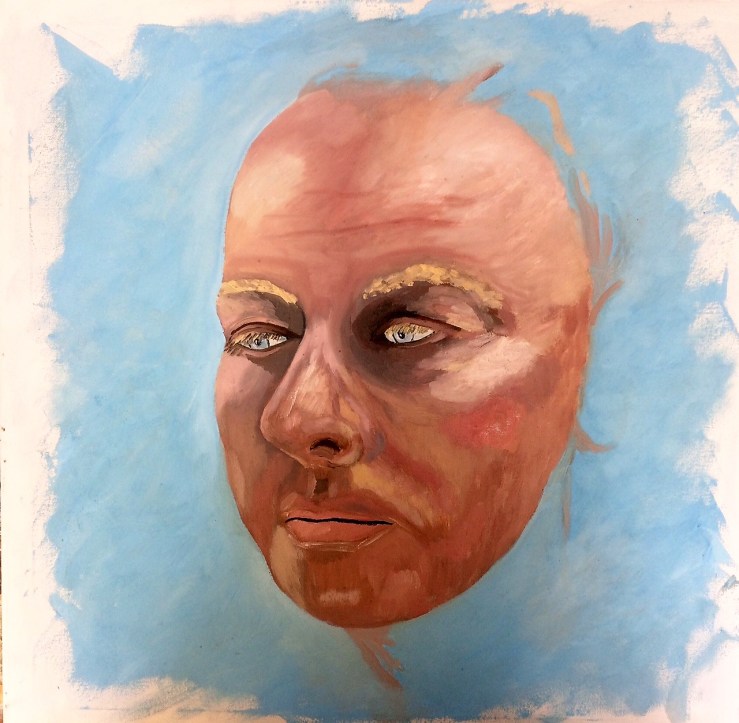
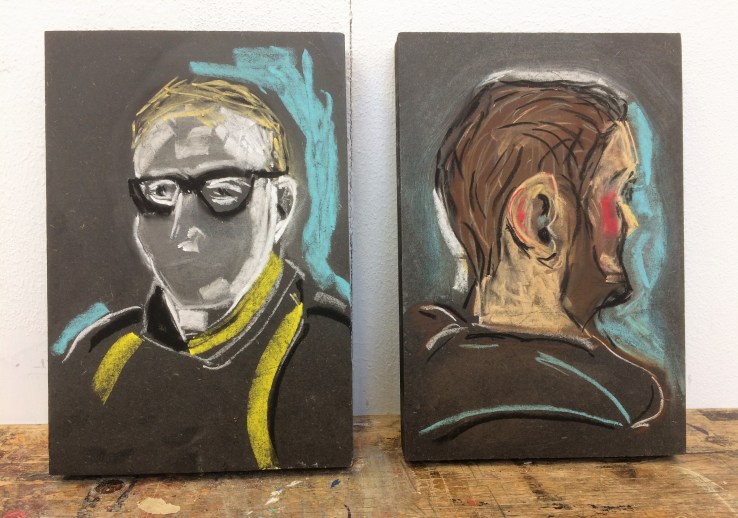
I started my project by doing some small pastel sketches of people around the studio followed by a larger oil sketch of a face on a blue ground. This face was devoid of hair and indeed a whole head, it was just the face with a slightly down turned gaze and without context.
CRIT
I didn’t receive an individual critique for this work however at the end of the exhibition week I did receive a tutor led group critique which was rather harsh but probably accurate. The general feeling was the work looked to unfinished and a little creepy. The flesh tones were not very realistic with the whole painting looking flat and didn’t really work also it did not communicate any specific feeling or emotion to the viewer which left some asking, why? The work would have been better used as an initial study rather than an exhibited work. Unfortunately there were no real suggestions on how to take the work further other than maybe to use other materials such as latex instead of paint? So as a critique it was quite hard to take solace or encouragement from or find motivation to improve.
I do like to paint and appreciate I have very limited ability but I am eager to improve and better myself, maybe being taught, instructed or tutored in painting and its technics or shown how to arrange a composition or use the materials in a more professional way would help and seems the most obvious solution but unfortunately this is not part of the curriculum.




 Michael Palmer